
The Future of Luxury Travel in the Caribbean – Moving Islands
Modern luxury is boring.
It’s just the same themes over and over again. So, we wanted to push the boundaries and reimagine what the future of luxury travel could look like.
Therefore, we zeroed in on the Caribbean Islands.
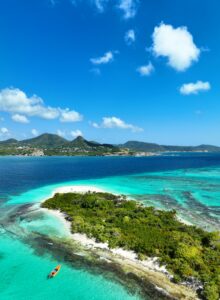
Luxury travel in the Caribbean, for the most part, has remained comfortably predictable. You’ve got opulent beachfront hotels, extravagant all-inclusive escapes, and private villas for the 1%.
But we believe something new is needed.
We think it should float. It should glide. It should redefine what it means when we say “destination.”
The future of luxury travel in the Caribbean could be shifting, both figuratively and literally. We’re talking about movable islands. Modular floating structures designed to act as full-scale luxury resorts, complete with staff, services, views, and privacy, only without permanent land.
Instead of picking a single destination to visit, travelers could choose how far they want their luxury to go, and where they want it to drift to next.
Floating Resorts – Ideal for the Caribbean
Some destinations are prime candidates for this sort of innovation, and the Caribbean is probably the most likely place for this concept to form.
The region already has some of the best resorts on earth and is known for its calm waters and bays, and relatively mild marine conditions for much of the year.
If you’re trying to float an entire resort, you’re going to need predictable conditions.
Add to that the abundance of small, underdeveloped islands in the region alongside the clear regulations around maritime activity, and you have the recipe to actually make movable hospitality a real option.
Instead of densely built-up resort corridors where expansion means squeezing another high-rise next to an already crowded beach, floating resorts would allow you to go where there’s space.
Untapped marine zones would become opportunities. Instead of building up and out, the region could build across the currently unmanned water. This type of expansion would also not stress local resources in the same way, either. Currently, new resorts in the Caribbean often run into limits like land use restrictions or environmental pushback. However, creating a floating resort could circumvent a lot of those issues by not being part of the land at all.
Mobility Redefining the Luxury Experience
The novelty of a a resort that doesn’t stay put alone could pull in the most seasoned luxury travelers who are asking, “What’s next?”
Well, this could be next.
Imagine waking up in a floating villa overlooking the Grenadines and, a few days later, watching the sun sink behind the hills of Dominica, without ever checking out or packing a bag. That type of fluid living would give you the combination of resort-living and cruise ship island hopping, but with much more privacy and control.
Luxury travel in the Caribbean would then no longer be about picking between two islands, but rather you could experience them in sequence, according to the rhythm with the sea.
The resort would travel, but the guest actually doesn’t. Or at least, not in the traditional sense.
Design-Forward, Not Just Floating
It would be a mistake to think of these movable islands as oversized rafts with a few chairs and a bar. They’re not.
The design concepts here would pull inspiration from superyachts, minimalist eco-retreats, and even contemporary interior designers, mixing durability with beauty in unexpected ways.
We’re talking the potential for angular modular pods that can interlock to scale up or shift to fit different needs, such as a honeymoon, private event, small groups, or solo escape.
Resorts in the Caribbean already push visual boundaries, but floating resorts have the added challenge of blending motion into their actual aesthetic. They could employ solar canopies, water-recycling systems, durable materials that can withstand the salty air, and structural shapes built to dance with the currents.
Even the interiors, from spa lounges to bedroom suites, would need to be created to feel solid while drifting.
Movable Privacy at a Whole New Level
Privacy is the foundation here.
Floating resorts would bring flexible isolation that land-based luxury just can’t replicate.
These modular islands wouldn’t get near anything unless you want them to be.
Current luxury resorts in the Caribbean have always sold tranquility and exclusivity, but they still come with neighbors and shared beaches.
This new model could create boundaries between the guest and the outside world in a way that’s peaceful and make you truly free and unbound.
Service That Changes With the Surroundings
When the resort moves, everything else moves with it, including the concept of service.
The idea here isn’t just bringing five-star amenities offshore as a one-to-one copy. Instead, we would seek tailored services that match the place the floating resort is currently sitting.
For instance, if you are parked near a vibrant marine preserve, then you could expect curated diving adventures, guided sea life explorations, and maybe even a sunset lecture from a marine ecologist.
When near a colonial-era harbor, you could receive wine pairings inspired by the port’s history or on-deck dining inspired by old island trade routes.
Staff would be dynamic as well. Chefs would create location-based menus. Wellness teams would offer treatments based on the time of day, the temperature, and even the wind direction.
The staff on floating resorts in the Caribbean would adapt to help change the personality of your experience based on location. For returning guests, that means no two stays will ever feel alike, even if you book the same structure twice.
Technology Makes It Possible
These modular islands would need to rely on modern technology. But it is clear today’s modern traveler would want that tech to be hidden and seamless when they are seeking an authentic island experience.
So, this concept would integrate things like dynamic anchoring systems that respond to ocean current and remote monitoring that keeps systems optimized into a centralized hub that is out of sight for guests.
On top of that, there would also be smart lighting, climate control, and adaptive soundscapes that work as part of the entire experience.
The goal is not to create a robot-powered cruise ship, but rather the feeling of a living, moving resort that uses technology to enhance everything overall.
Movable island resorts would need to take the polish that current properties are known for and make it adaptive, tailoring each moment to the traveler’s intent rather than a hotel’s schedule.
Eco-Friendly by Necessity
Environmental responsibility would be a mandatory cornerstone within this concept and not just a nice-to-have to quell the conscience of the travelers.
Floating resorts can’t afford to be wasteful since they don’t plug into a grid and would often be too remote for regular supply runs.
So, they will need to produce their own energy, filter their own water, and manage waste like a self-contained village.
An ideal setup would incorporate solar and wind as their primary power sources, along with energy storage systems that are smart enough to anticipate usage patterns based on weather forecasts and guest preferences.
These floating resorts in the Caribbean offer an opportunity to bring visitors closer to nature without harming it, allowing guests to enjoy pristine locations without contributing to their decline.
That could be an important feature for today’s luxury traveler, especially the rising generation of eco-focused explorers with deep pockets and even deeper values.
Work with the Weather
Caribbean weather is usually beautiful and tranquil, but there are still some significant threats.
Hurricanes, tropical storms, and strong seasonal winds are all real risks for resorts in the region.
But floating resorts in the Caribbean could have a built-in answer: movement.
With enough notice, the entire structure can shift to safety. Some can even be partially submerged or secured in natural coves for protection.
Guests might not even notice a subtle change in location. And for resort operators, it would mean less downtime, less damage, and fewer cancellations.
That means there will always be an experience at a safer, equally scenic location at any given moment within the Caribbean Sea.
Local Economies Benefit From a Different Angle
People might assume floating resorts could pull business away from land-based destinations, but it not be fully true.
These resorts would still rely on local infrastructure, but in different ways, including the use of supply chains, guest excursions, docking services, and entertainment partnerships.
Local boat owners would be contracted as transport, while chefs could source ingredients from island markets.
Meanwhile, guides could be brought in and hop aboard for short-term experiences and then disembark.
Some smaller islands may even welcome floating resorts that dock seasonally offshore, bringing in high-value guests without requiring new construction or straining utilities.
Travelers could actually receive a taste of the local culture everywhere they go, but still have the luxuries of their own oasis.
The Future is Floating
The best luxury resorts in the Caribbean may soon include structures with no physical address. Resorts that live on the water, move with the seasons, and shift to meet the moment would be in the highest demand.
It’s the type of change that the travel industry could use and make how people think about travel shift entirely.
We would see flexibility become the core of the experience.
And for those able to pay for that freedom, the Caribbean becomes a whole luxury region that flows with multiple destinations.
So, what could unfold now is a new way to move through the world.