
How to Spend 42 Hours in Hamburg: Famous Sights & Hidden Corners
My recent weekend in Hamburg took me around from famous concert halls through centuries-old warehouse streets, into a tiny riverside neighborhood that resembled an old-time village, and eventually to a Sunday morning fishmarket where late-night partygoers mixed with tourists buying fish before breakfast.
So, why 42 hours? Well, that is the exact amount of time I had planned for this portion of my journey across Germany.
Hamburg surprised me more than I expected and that’s why I wanted to share with you my experience.
Before this trip, I knew about the enormous harbor, the Elbphilharmonie, and the Reeperbahn (the city’s most famous nightlife street). But, what stayed with me were often the smaller discoveries between those famous attractions: old sailors’ houses near the waterfront, narrow passages I nearly walked straight past, and quiet canals that offered a piece of tranquillity within Germany’s second-largest city.
Looking back, 42 hours was hardly enough to know Hamburg completely, but it was enough to experience its contrasts.
Here is how those 42 hours unfolded.
Friday Evening: Speicherstadt, Hidden Streets, and Hamburg After Dark
Arriving in Hamburg
My husband and I arrived in Hamburg by plane in the late afternoon. We picked a hotel near the Jungfernstieg subway stop, which was very convenient for us because we could easily take public transport from where we stayed.
But, during our stay, we tried to walk as much as possible, to experience not only the views and buildings that the city has to offer, but also the general vibes among locals and tourists.
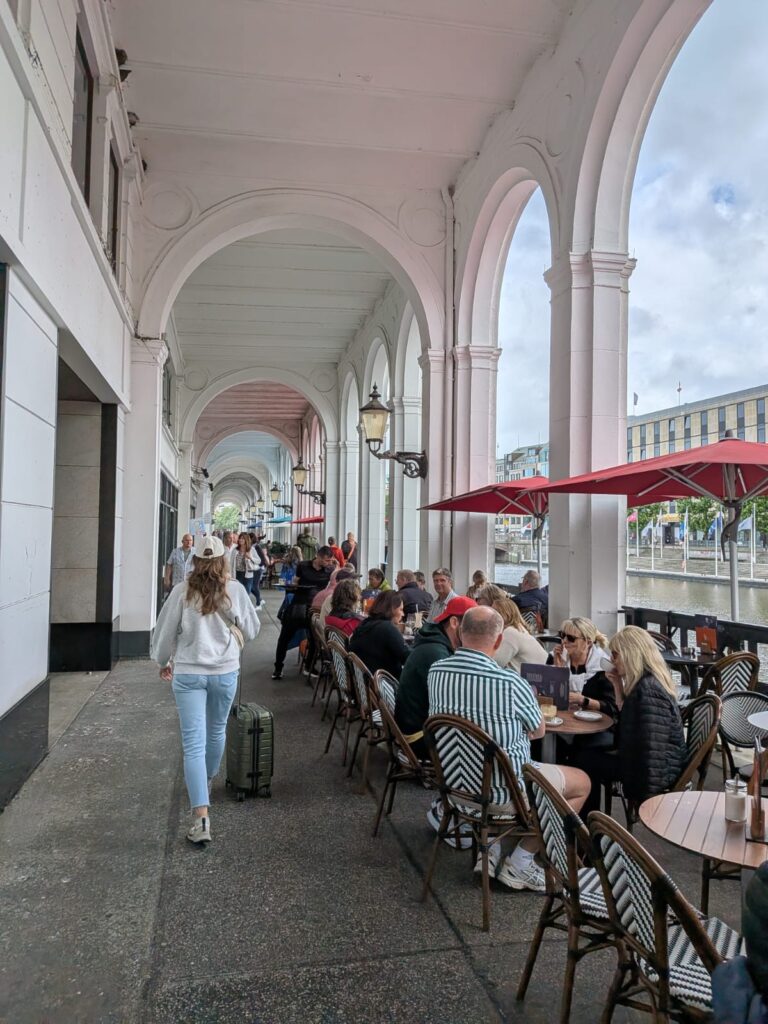
Hamburg turned out to be particularly rewarding on foot. Water constantly appeared all around us, sometimes as an enormous river and sometimes as a narrow canal squeezed unexpectedly between historic buildings.
Our first destination was the Speicherstadt, the famous Warehouse District, which we reached easily from where we stayed with the subway in 10 minutes.
Getting Lost in Speicherstadt
Walking through the Speicherstadt was one of my favorite experiences of the whole weekend.
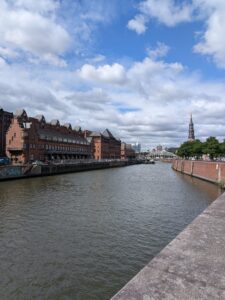
The historic warehouse district is filled with huge red-brick buildings that were built during the 1880s, rising directly beside narrow canals. Bridges connect the different sections, and every crossing revealed a picture-perfect view of water and bricks.
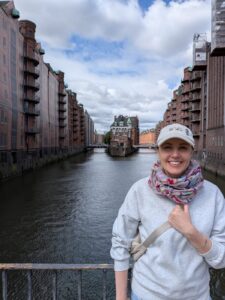
As I have learned preparing for this trip, coffee, tea, spices, and carpets once moved through these warehouses as part of Hamburg’s international trading economy. Today, Speicherstadt forms part of a UNESCO World Heritage Site alongside the nearby Kontorhaus district and Chilehaus.
As evening approached, the lights around this district began reflecting in the canals and Speicherstadt became even more atmospheric. So, make sure you get to see it during the day and the evening.
The Elbphilharmonie and HafenCity
From Speicherstadt, we walked to HafenCity. Here, the old brick warehouses, typical of the Speicherstadt district, have been replaced by glass apartments, contemporary offices, broad promenades, and eventually the very famous Elbphilharmonie.
This enormous concert hall rises above a historic warehouse beside the river Elbe (therefore, its name), with its glass upper structure creating one of Hamburg’s most recognizable silhouettes.
We reached the top of the Elbphilharmonie to have a 360-degree panorama view of Hamburg, which gave me the first real sense of Hamburg’s scale. This city is really huge!
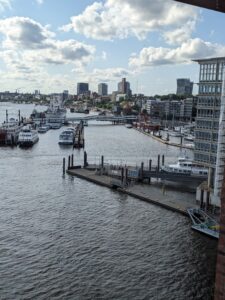
Church towers appeared behind me while cranes, cargo ships, docks, and industrial machinery stretched across the opposite side of the river.
Hamburg is a beautiful city in its own way, different from Paris or Milan. It’s a city where heavy industry was part of the scenery rather and has been incorporated into our modern lives.
Kramer-Witwen-Wohnungen, a Tiny Piece of Old Hamburg
Before dinner, we squeezed in one place that many visitors often walk straight past.
Near St. Michael’s Church are the Kramer-Witwen-Wohnungen, which is a tiny historic courtyard complex originally built as housing for widows.
Walking into the narrow passage gave us the feeling of uncovering a miniature version of old Hamburg hidden behind the modern city.
The tightly packed historic buildings here were a striking contrast to the enormous scale of the ultra-modern Elbphilharmonie we had just left.
It didn’t take long to explore and it added a different feeling to the vibes of this multifaceted city.
Dinner Near the Portuguese Quarter
For dinner, we reached the Portuguese Quarter near Landungsbrücken.
Here, Portuguese, Spanish, and Mediterranean restaurants fill the streets, with seafood being offered at virtually every restaurant. So, since we were hungry by this time, eating seafood was a must for us.
We slowed down here for a proper dinner and enjoyed a cozy and relaxed meal.
St. Pauli Beyond the Reeperbahn
Eventually, we reached the St. Pauli district and we walked along the main famous street, the Reeperbahn .
The Reeperbahn was everything I expected: neon, crowds, clubs, theaters, bars, music, and organized chaos.
Hamburg’s connection with The Beatles runs deeply through this neighborhood. In fact, I have learned that before their international fame, the band spent some time playing numerous sets across different clubs in Hamburg.
We then wandered around Große Freiheit and the neighboring streets before eventually heading back toward our hotel.
At the end of the day we were exhausted, but Hamburg already revealed so much of itself!
Saturday: From Elegant Hamburg to Its Industrial Heart
Franzbrötchen for Breakfast
Our Saturday began with a coffee and a Franzbrötchen – the cinnamon-heavy local pastry that you absolutely need to try if you visit the city!
Fueled by coffee and sugar, it was time for us to head toward the Rathaus, the Hamburg Town Hall.
Rathaus and the Alster
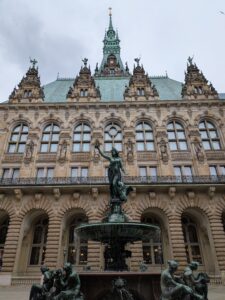
The Hamburg Rathaus dominates its surrounding square with a Neo-Renaissance façade that matches the grandeur of such a historically wealthy trading city.
After exploring the surrounding streets, we continued toward Binnenalster.
This was where Hamburg changed personality again.
Here, we watched sailboats move across the water while elegant buildings lined the shore. I spent some time walking beside Binnenalster rather than attempting the much longer loop around Außenalster.
Chilehaus and the Kontorhaus District
From the Alster, we walked to the direction of the Kontorhaus District and we stopped at the Chilehaus.
The building is famous among architecture enthusiasts for its dramatic brick façade and sharp, ship-like eastern corner.
The surrounding Kontorhaus district also helped me understand another side of Hamburg’s commercial history.
These enormous office buildings represented a different chapter from Speicherstadt’s warehouses, yet both were products of the trade and wealth that shaped the city.
St. Nikolai and Deichstraße
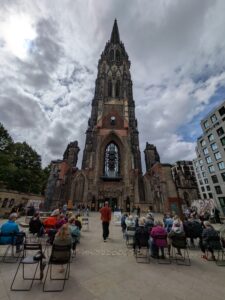
From there, we continued toward the St. Nikolai Memorial.
The surviving tower and ruins stand as a reminder of Hamburg’s destruction during World War II. The carillon in the tower of the St. Nikolai Memorial is composed of 51 bells that are played live every Thursday and occasionally on Sundays.
Nearby, the Deichstraße offered another window into an older city.
The historic merchant houses lining the street survived in a city where so much earlier architecture disappeared through fire, war, and redevelopment. The street itself was small, but that was precisely what I liked about it.
Around the Deichstraße, I spent some time looking at Nikolaifleet, one of Hamburg’s historic canals.
This quieter waterside perspective felt surprisingly removed from the busy center.
Old buildings rose directly from the canal edge, creating one of those views that explained why Hamburg’s waterways are such an important part of its character.
It was a small detour, yet one of my favorite discoveries.
Fischbrötchen by the Harbor
By lunchtime we were super hungry, but we didn’t want to stop for a long time at a restaurant, therefore we grabbed a fischbrötchen, a “sandwich with fish”.
You can pick one (or more!) of these sandwiches in different variations: with herring, salmon, shrimp, and fried fish.
Don’t expect to have the most sophisticated meal of your life, but if you want to get filled up with something local and tasty, a fischbrötchen is a must try.
A Harbor Cruise
Our most touristy activity of the weekend was also one of the best of the whole weekend, and one that I highly recommend: a harbor cruise.
We boarded at the Landungsbrucken Bridge 3 and our tour covered these sights: the container terminals, the fishmarket, the Elbstrand, HafenCity, and the Elbphilharmonie.
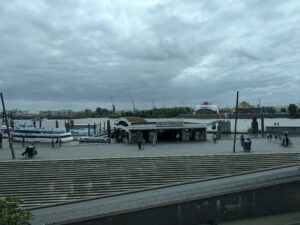
During the cruise, we were able to see container terminals, dry docks, cranes, warehouses, tugboats, and enormous commercial ships surrounding us.
Hamburg has such a variety of landmarks and sights that it is a beautiful city to discover both by feet and on water!
Park Fiction
In the later afternoon, we made a stop at Park Fiction. This is a small public space overlooking the Elbe. It isn’t grand or particularly polished, but for us it was the perfect spot to just sit, relax, and watch people walking by us.
After spending a lot of time surrounded by major attractions, simply sitting among locals and watching the Elbe felt refreshingly ordinary.
Sternschanze
For the evening of Saturday we headed towards the Sternschanze neighborhood.
Here, we found street art, independent businesses, cafés, bars, and restaurants that gave this area a completely different energy from central Hamburg.
Sternschanze felt less like somewhere designed for visitors and more like a neighborhood where we would happen to spend a Saturday night if we were Hamburg locals. It was the perfect experience for us!
Sunday Morning: Hamburg’s Strangest Hours
Fish Market
Getting up for Hamburg’s Sunday Fischmarkt after Saturday night wasn’t pleasant, but we were sure it would have been worthwhile. And, in fact, it was.
The market brought together one of the strangest mixtures of people I encountered during the weekend.
Vendors were setting up and selling goods while early-morning shoppers moved between stalls. Tourists wandered around with coffee. Meanwhile, some people clearly appeared to be finishing their Saturday night rather than beginning Sunday morning.
That beautiful (and strange) mix is part of what makes Fischmarkt’s personality so intriguing.
We grabbed breakfast and coffee while watching Hamburg wake up. Such a worthy experience!
Övelgönne and the Historic Ships
For our final few hours, we walked farther west along the Elbe toward Övelgönne.
This was one of my favorite lesser-known discoveries.
Nearby pathways, old houses, river views, and small beaches removed us from the (relative) hustle and bustle of central Hamburg.
We loved just standing beside the Elbe while watching enormous ships pass. The village-like streets here were one final example of Hamburg’s ability to completely change character within a relatively short distance.
One Last Coffee & Goodbye
42 hours didn’t allow me to see everything in Hamburg, but that was never really the plan anyway (and gives us an excuse to come back soon).
In less than two days, I experienced centuries-old warehouses beside futuristic architecture, peaceful lakes and enormous container terminals, local pastries and harbor-side Fischbrötchen, quiet parks and crowded nightlife districts.
The biggest impression Hamburg left on me was its contrasts.
Few cities I’ve visited can shift so naturally between elegant and industrial, historic and modern, peaceful and chaotic.
My 42 hours gave me enough time to experience all of those personalities.
More importantly, they gave me plenty of reasons to come back.
Best Seasons to Visit Hamburg
The amount of time I spent walking made one thing obvious: the season can significantly change a Hamburg trip.
May and June are the two best months to visit. There are longer days, which are extremely valuable during a short stay, and the fresh, not super hot temperature of late spring makes waterfront walks, parks, harbor cruises, and outdoor dining very enjoyable.
July and August bring warmer, longer, and sunnier days. Hamburg feels particularly active and locals take advantage of the good weather not only practicing outdoor activities, but also gathering around the Alster and Elbe, playing at parks, and enjoying cafés kissed by the sun.
September offers an interesting compromise. Conditions can still be pleasant for walking while the busiest summer travel period starts to fade.
October through March brings a moodier version of Hamburg. Gray skies, wind, rain, and cold weather somehow suit Speicherstadt’s brick warehouses and maritime atmosphere, although shorter days require more careful sightseeing plans.
December has its own appeal because Christmas markets and seasonal decorations transform parts of the center.
Whatever the season, I found that waterproof clothing and layers were the best way to be dressed for this city. The weather in Hamburg can change quickly, so make sure to be ready for sunny and warm mornings to cloudy and cooler nights.
Best Neighborhoods to Stay in Hamburg
A central neighborhood made our 42-hour schedule much easier. So, if you are planning to also visit the city for a short period of time, you might want to consider where to stay based on what you want to see.
These are my suggestions regarding the major neighbourhoods in Hamburg:
Altstadt is the prime neighborhood for classic sightseeing. Rathaus, central shopping streets, canals, and several major attractions are close, while Speicherstadt and the Alster remain easily accessible.
Neustadt offers one of the best overall locations. It sits conveniently between central attractions, the Alster, St. Pauli, and the waterfront, making it especially practical for a short first visit.
HafenCity provides a completely different, contemporary experience. Modern architecture, Speicherstadt, and the Elbphilharmonie are right outside, while early mornings along the waterfront can be surprisingly peaceful.
St. Pauli is better suited to travelers who want nightlife integrated into the trip. The Reeperbahn, Landungsbrücken, music venues, and harbor are nearby, although weekend noise can become part of the experience.
Sternschanze was my favorite area for a more local-feeling evening. Independent restaurants, cafés, bars, and street life give it a personality that feels less centered around traditional sightseeing.
This is all I can share about our 42 hours spent in Hamburg!I hope you found this guide useful and it inspired you to visit this city very soon!